Adding LLBLGen to the Dapper performance benchmark test project
The Dapper project on GitHub has a performance/benchmark test project that compares a number of ORMs and data access strategies. While the project only tests a very simple fetch algorithm, it's a good
The Dapper project on GitHub has a performance/benchmark test project that compares a number of ORMs and data access strategies. While the project only tests a very simple fetch algorithm, it’s a good starter indicator for performance. I thought I would add one of my favorite ORMs (LLBLGen) to the mix, and see how it performs. Code samples are included in this post. The Dapper project hosted on GitHub at https://github.com/SamSaffron/dapper-dot-net has a performance/benchmark test project that compares a number of ORMs and data access strategies. While the project only tests a very simple fetch algorithm, it’s a good starter indicator for performance. I thought I would add one of my favorite ORMs (LLBLGen) to the mix, and see how it performs. > Post update: 5/3/2013 > > LLBLGen has recently published it’s V4 release. In addition to this post, you may also be interested in these LLBLGen Pro v4 benchmarks.
The Tests
Here’s the code I added to the PerformanceTests.cs class file. Use this code, in conjunction with the download further down to perform the tests yourself if you’re familiar with LLBLGen. Here are the LLBLGen Adapter Tests:
//LLBLGen Adapter
var adapter1 = new DataAccessAdapter(Program.connectionString, true, CatalogNameUsage.Clear, null);
adapter1.OpenConnection();
tests.Add(id => adapter1.FetchEntity(new PostEntity(id)), "LLBLGen Adapter (FetchEntity w/ KeepConnectionOpen)");

var adapter2 = new DataAccessAdapter(Program.connectionString, false, CatalogNameUsage.Clear, null);
adapter2.OpenConnection();
tests.Add(id => adapter2.FetchEntity(new PostEntity(id)), "LLBLGen Adapter (FetchEntity)");

var adapter3 = new DataAccessAdapter(Program.connectionString, true, CatalogNameUsage.Clear, null);
adapter3.OpenConnection();
tests.Add(id =>
  {
      var bucket = new RelationPredicateBucket();
      bucket.PredicateExpression.Add(PostFields.Id == id);
      var entities = new EntityCollection();
      adapter3.FetchEntityCollection(entities, bucket);
      entities.First();
  }, "LLBLGen Adapter (Predicate w/ KeepConnectionOpen)");

var adapter4 = new DataAccessAdapter(Program.connectionString, false, CatalogNameUsage.Clear, null);
adapter4.OpenConnection();
tests.Add(id =>
  {
      var bucket = new RelationPredicateBucket();
      bucket.PredicateExpression.Add(PostFields.Id == id);
      var entities = new EntityCollection();
      adapter4.FetchEntityCollection(entities, bucket);
      entities.First();
  }, "LLBLGen Adapter (Predicate)");
Here are the LLBLGen Self-Servicing Tests:
//LLBLGen SelfServicing
CommonDaoBase.ActualConnectionString = Program.connectionString;
tests.Add(id => (new LLBLGenSS.EntityClasses.PostEntity()).FetchUsingPK(id), "LLBLGen SelfServicing (UC Fetch)");

tests.Add(id => new LLBLGenSS.EntityClasses.PostEntity(id, (IPrefetchPath)null), "LLBLGen SelfServicing (PK in constructor)");

tests.Add(id =>
  {
      var entities = new LLBLGenSS.CollectionClasses.PostCollection();
      entities.GetMulti(LLBLGenSS.HelperClasses.PostFields.Id == id);
      entities.First();
  }, "LLBLGen SelfServicing (Predicate)");
var transactionManager = new LLBLGenSS.HelperClasses.Transaction(IsolationLevel.ReadUncommitted, "Test", Program.connectionString);
tests.Add(id =>
  {
      var entity = new LLBLGenSS.EntityClasses.PostEntity();
      transactionManager.Add(entity);
      entity.FetchUsingPK(id);
  }, "LLBLGen SelfServicing (UC Fetch in Transaction)");
Now let’s see the results.
The Results
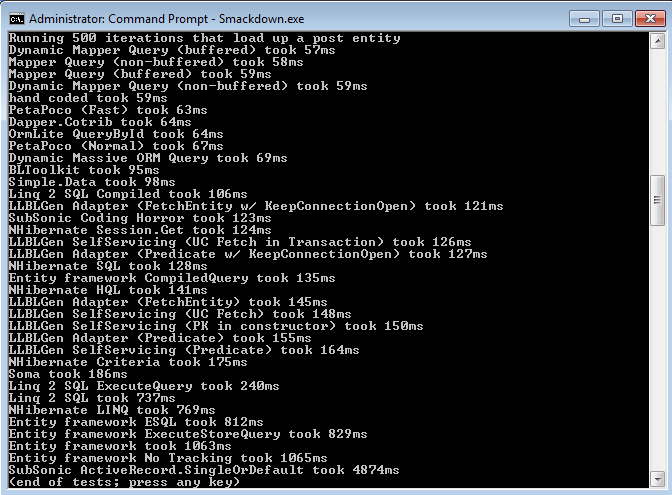 In plain text format:
| Strategy | Time |
|---|---|
| Dynamic Mapper Query (buffered) | 57ms |
| Mapper Query (non-buffered) | 58ms |
| Mapper Query (buffered) | 59ms |
| Dynamic Mapper Query (non-buffered) | 59ms |
| hand coded | 59ms |
| PetaPoco (Fast) | 63ms |
| Dapper.Cotrib | 64ms |
| OrmLite QueryById | 64ms |
| PetaPoco (Normal) | 67ms |
| Dynamic Massive ORM Query | 69ms |
| BLToolkit | 95ms |
| Simple.Data | 98ms |
| Linq 2 SQL Compiled | 106ms |
| LLBLGen Adapter (FetchEntity w/ KeepConnectionOpen) | 121ms |
| SubSonic Coding Horror | 123ms |
| NHibernate Session.Get | 124ms |
| LLBLGen SelfServicing (UC Fetch in Transaction) | 126ms |
| LLBLGen Adapter (Predicate w/ KeepConnectionOpen) | 127ms |
| NHibernate SQL | 128ms |
| Entity framework CompiledQuery | 135ms |
| NHibernate HQL | 141ms |
| LLBLGen Adapter (FetchEntity) | 145ms |
| LLBLGen SelfServicing (UC Fetch) | 148ms |
| LLBLGen SelfServicing (PK in constructor) | 150ms |
| LLBLGen Adapter (Predicate) | 155ms |
| LLBLGen SelfServicing (Predicate) | 164ms |
| NHibernate Criteria | 175ms |
| Soma | 186ms |
| Linq 2 SQL ExecuteQuery | 240ms |
| Linq 2 SQL | 737ms |
| NHibernate LINQ | 769ms |
| Entity framework ESQL | 812ms |
| Entity framework ExecuteStoreQuery | 829ms |
| Entity framework | 1063ms |
| Entity framework No Tracking | 1065ms |
| SubSonic ActiveRecord.SingleOrDefault | 4874ms |
Download
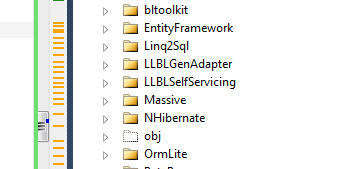
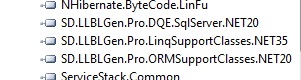
To run the LLBLGen test, just include the 2 folders in the attached zip file into the Dapper project, and reference the LLBLGen assemblies
Project:
References:
 [Download Code](/funcoding/files/2012/02/LLBL.zip)
Conclusion
While LLBLGen is not a Micro-ORM, the LLBLGen Adapter and SelfServicing runtime frameworks rank up there at the top performance-wise. I’ve worked with Entity Framework extensively in the past few months, including Code-First, even though that doesn’t make me an expert, but none-the-less, LLBLGen is more attractive now than ever before. We’ll see how EF 5.0 turns out. Meanwhile, NHibernate, PetaPoco, Dapper, and LLBLGen all look like good options.
Separate study (updated on 4/20/2012)
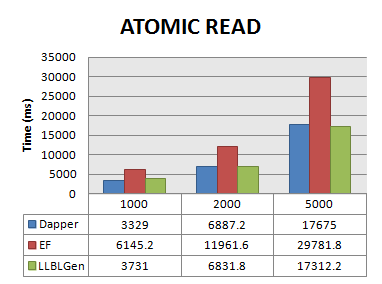
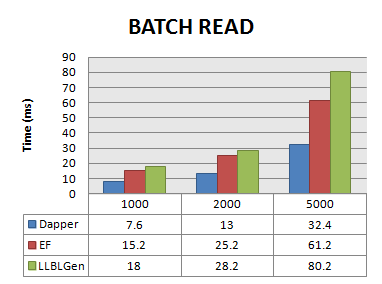
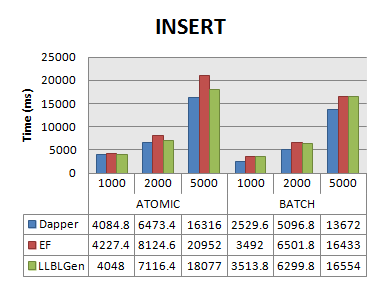
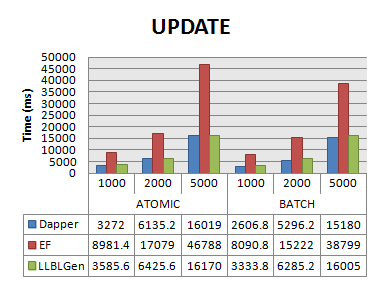
I found the codebase I used a while back to compare basic CRUD operations between EF 4.1, Dapper and LLBGen 3.1. I took a quick stab at refactoring it a little with newer libraries and here are the findings. The results are in milliseconds, and are averages taken over 5 iterations of 1000, 2000, and 5000 user records. Code is provided as a download. I make a distinction in my tests between BATCH and ATOMIC transactions. A BATCH transaction is a transaction over the entire span of records (start_transaction foreach { do_record_update } commit_transaction); whereas, an ATOMIC transaction is a transaction on each individual record (foreach { start_transaction do_record_update commit_transaction }).
 |  |
 |  |
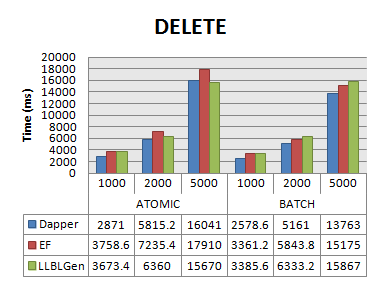 |
All frameworks “delete”, and “insert” about the same. Dapper clearly outperforms both LLBGen and EF in batch reading data out of a database (although, all frameworks retrieve over 5000 records in less than 90ms in my tests, which is probably good enough for most applications), unless you’re running a site like StackOverflow, in which case, you might as well switch to a search engine instead. LLBLGen is a near 2nd, EF takes 3rd place (with some concerns in the area of “atomic reads” and “updates”). Of course, I make assumptions in my tests, and the database in these tests is not indexed, so this isn’t the final say on the matter, take it as you will  . [Separate Study Code](/funcoding/files/2012/04/misc_orm_perf_tests.zip)
Comments
Comments are moderated. Your email is never displayed publicly.